

Poetry is one of the most powerful forms of expression. It allows writers to capture emotions, tell stories, and deeply explore human understanding through carefully chosen words and structured language.
Unlike other forms of literature, poetry uses meter, rhyme, and rhythm to create a unique and aesthetic reading experience. Maybe this is why crafting a great poem that can get the readers hooked is so hard. This is where AI tools like our AI Poem Generator can come in handy.
It provides inspiration and assistance in various forms of poetic compositions. Having said that, we will delve into discussing all about different types of poems and show you how our tool can help you write them. But before we get into all that, let us briefly explain what exactly a poem is for those who are unfamiliar with the concept.
A poem is a form of literature in which a writer usually expresses their feelings and ideas. These things are given intensity by the use of distinct style and rhythm.
In poems, language is used carefully, every word is chosen to evoke emotions, create imagery, and convey a deeper meaning. Additionally, poetry can be as short as a couple of lines or can consist of multiple pages. It can also adhere to strict rules or embrace free expression.
There are quite a few types of poems out there. However, some of the most commonly recognized ones are:
We will now explore each of these types below.
A free verse poem is one of the most liberating forms of poetry. This is because, unlike traditional forms, free verse does not follow a specific rhyme scheme, meter, and structure.
This allows the poet to write however they like. They can write in a way that mimics speech rather than a poem. The length is also not an issue here as free verses can be as long as the poet wants and the grammar structures are continuously repeated.
Basically, there are no formal rules that have to be followed in free verse.
As mentioned, free verse doesn’t exactly follow a strict structure. However, it often relies on line breaks, punctuation, and the arrangement of words so the poem can at least make some sense to the reader.
Additionally, the structure in free verse is determined by the poet’s intention, whatever they want can be achieved.
While free verse lacks the general rules of a traditional poem, some guiding principles are as follows:
Use of Imagery: Using strong and vivid imagery in the poem can enhance the reader's experience. They can better understand what the poem is about.
Line Breaks and Punctuation: The poem’s pacing and flow can be influenced using these elements. If they are used right, the poetry becomes more interesting.
Repetition: Repeating words, phrases, and ideas can add emphasis and cohesion to the poem.
Since free verses can be quite long, we’re going to go with a short one as an example. Below is “The Red Wheelbarrow” by William Carlos Williams.
“so much depends
upon
a red wheel
barrow
glazed with rain
water
beside the white
chickens.”
This example will give you a general understanding of what a free verse is like. You can see that the poem makes little to no sense and there is not much context present. The initial word in each line is also not capitalized. No conventional rule is followed.
Our tool can work well for crafting a great free verse poem. You can generate them in an instant by following the steps mentioned below.


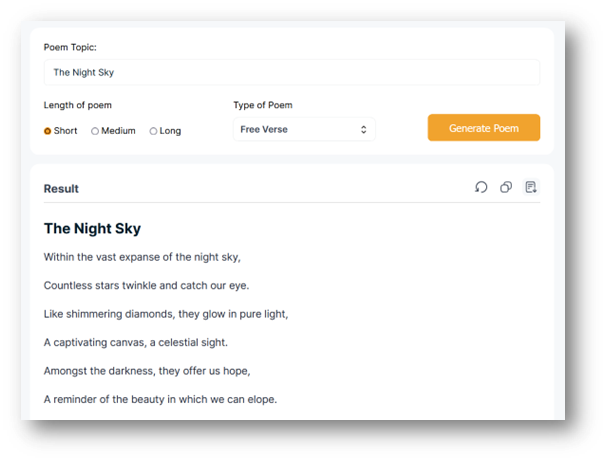
In our case, the output provided by the AI Poem Generator can be seen in the image above. The textual version of it is as follows:
The Night Sky
Within the vast expanse of the night sky,
Countless stars twinkle and catch our eye.
Like shimmering diamonds, they glow in pure light,
A captivating canvas, a celestial sight.
Amongst the darkness, they offer us hope,
A reminder of the beauty in which we can elope.
A limerick is often a light-hearted, humorous poem consisting of five lines in total. It follows a specific rhyme scheme (AABBA) and has a unique rhythm that makes it easy to remember, fun, and exciting.
Additionally, a limerick poem is commonly associated with wit and playfulness. They can’t be used to talk about serious stuff like the passing of a loved one.
This type of poem usually has to follow the structure mentioned below.
Lines 1 and 2: These lines include setting a scene or introducing a character while following an 8-syllable pattern. It then ends with a rhyming word.
Lines 3 and 4: Shorter lines than 1 and 2. They usually have 5-6 syllables and rhyme with each other.
Line 5: Here, the 8-syllable pattern has to be followed again. It rhymes with the first two lines and often provides a humorous and unexpected conclusion.
While crafting a limerick poem, the following rules have to be followed.
Rhyme Scheme: AABBA.
Syllable Count: Typically, 8-8-5-5-8, but slight variations in lines 3 and 4 are common.
Tone: Generally humorous, with a twist or punchline at the end.
“There was an Old Man with a Beard” by Edward Lear is one of the prominent limerick poems. We’re using it as an example below to give you a better understanding of this poetry type.
“There was an Old Man with a beard,
Who said, "It is just as I feared!
Two Owls and a Hen,
Four Larks and a Wren,
Have all built their nests in my beard!”
As can be seen, the ending of the poem is humorous and has a bizarre meaning. This is exactly what a limerick is supposed to be like.
A great limerick can be crafted using our tool. We’ve already mentioned the general steps for using it in the section above.
However, to craft a limerick rather than a free verse, there is one thing that you have to do differently and it is to select the “Limerick” option under the “Type of Poem”. Once this is done, you’ll receive the output, as can be seen in the image below.
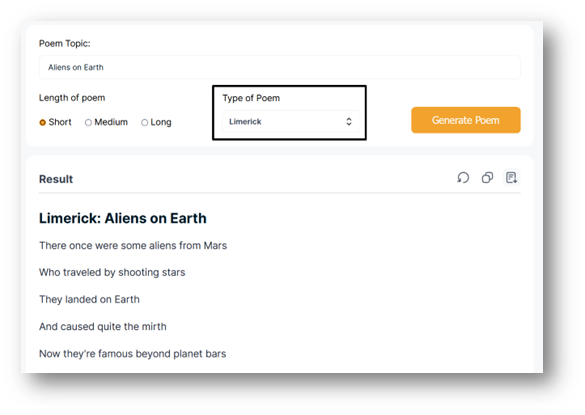
Against our provided topic, the tool generated this limerick. Here it is in a textual form:
Aliens on Earth
There once were some aliens from Mars
Who traveled by shooting stars
They landed on Earth
And caused quite the mirth
Now they're famous beyond planet bars
An acrostic poem is one in which the first, last, or other letters in each line spell out a word, name, or phrase when read vertically. The word or message is often related to the theme of the poem. It often adds an extra layer of meaning to the context.
Additionally, it is worth mentioning that the most common and simple form of an acrostic poem is when the first letter of each line spells something out.
These poems are usually taught to children during primary school. Their main purpose is fun and casual use rather than serious and high-level academic settings.
A great acrostic poem usually has the following structure.
Vertical Word or Name: The first letters of each line of the poem should form a word when spelled vertically. Careful consideration is required here.
No Rhyme or Meter: Acrostic poems don’t need a rhyme scheme or follow a specific meter. However, if the poet wants it, they can add these elements even though they are not needed.
There are two main rules that you should follow while writing an acrostic poem.
Word Choice: The word or phrase spelled out should be central to the poem’s theme.
Line Relevance: Each line should connect to the overall theme or the word being spelled.
To show you what an acrostic poem looks like once it’s completed, we’ve come up with this example ourselves. It spells out “SUNSHINE” when looking at the first letter of each line vertically.
“Softly it rises,
Up above the horizon,
Nurturing the earth below,
Spreading warmth and light,
Hues of gold and orange,
In every corner it reaches,
New life begins to grow,
Endless energy, pure and bright.”
Our tool is well-equipped to generate acrostic poems that you can use as reference and inspiration. To use it, you have to follow the general steps that we mentioned earlier but when it comes to selecting the type of poem, go with “Acrostic”.
Once done, the tool will come up with an output that’ll look something like the image attached below.
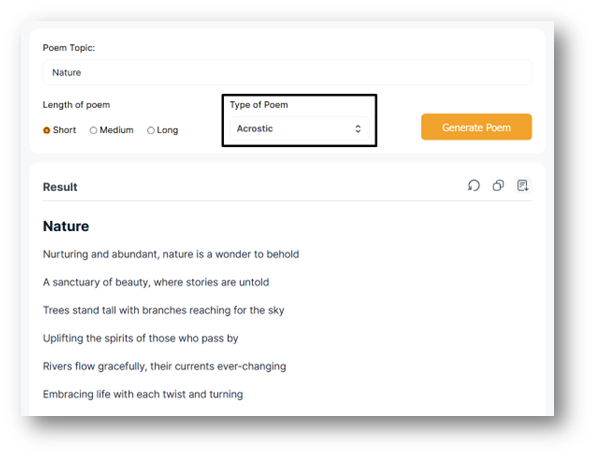
We gave the tool the topic “Nature” and you can see that it spelled it through the first letters of each line in the generated poem. The same output can be seen below in its textual form.
Nature
Nurturing and abundant, nature is a wonder to behold
A sanctuary of beauty, where stories are untold
Trees stand tall with branches reaching for the sky
Uplifting the spirits of those who pass by
Rivers flow gracefully, their currents ever-changing
Embracing life with each twist and turning
An epitaph is a short poem that is written in memory of someone who has passed away. Epitaphs are also engraved on tombstones as a gesture of love. They are somber and reflective, capturing the essence of the person being remembered in a few touching lines.
Additionally, since the poem is for celebrating the memory of the deceased, it usually has a serious tone rather than humorous or witty.
The following are some of the structural elements of an epitaph poem.
Concise and Reflective: Epitaph poems are usually short. 2-4 lines are common, anything longer than that doesn’t work.
Occasional Rhyming: These poems often rhyme but not always. This is because when memorializing someone, rhyming isn’t that important.
Respectful Tone: The tone is usually respectful and reverent. Mainly because the focus is on the virtues or legacy of the deceased.
Epitaph poems have to be written while following the rules mentioned below.
Simplicity: Keep the language simple and direct.
Meaningful Content: Focus on what made the person special or how they should be remembered.
Emotion: Convey the appropriate emotions, whether it be sorrow, respect, or even a celebration of life.
To provide you with a better understanding of what an epitaph poem is like, here’s one we wrote in remembrance of an artist.
“Her hands carved beauty from stone,
Her heart-shaped warmth from cold clay,
In her art, her soul is known,
Her spirit will never fade away.”
Writing an Epitaph poem becomes way easier with our tool. To generate such a poem, you have to provide the tool with the title of your poem, select the length that you want the poem to be, choose “Epitaph” from the provided types, and hit the “Generate Poem” button.
After doing this, you will receive the output which will look something like the following image.
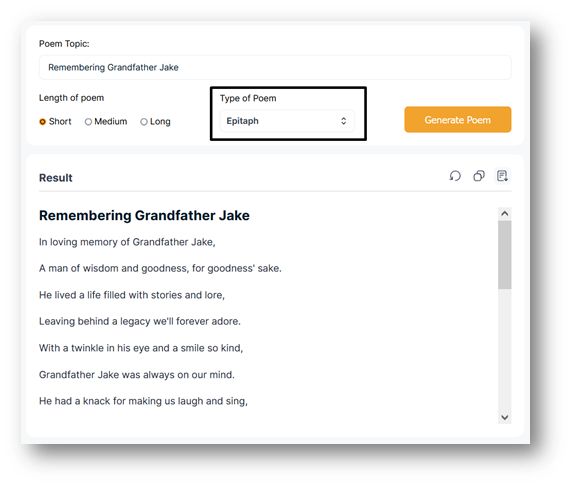
We used tool to generate an epitaph poem for remembering an imaginary grandfather named Jake. The output it provided was impressive and touching, as can be seen. Also, the textual version of the generated poem is as follows.
Remembering Grandfather Jake
In loving memory of Grandfather Jake,
A man of wisdom and goodness, for goodness' sake.
He lived a life filled with stories and lore,
Leaving behind a legacy we'll forever adore.
With a twinkle in his eye and a smile so kind,
Grandfather Jake was always on our minds.
He had a knack for making us laugh and sing,
With jokes and tales that would make our hearts spring.
Through his wrinkled hands and weathered face,
We could see the strength and love he embraced.
He taught us to cherish every moment we find,
To be grateful for the memories and leave no regrets behind.
Grandfather Jake was a pillar of strength and grace,
With his guidance, we found our rightful place.
He taught us the importance of family and loyalty,
And in his honor, we'll continue his legacy.
Though he's no longer with us, his spirit lives on,
In the stories we share and the lessons we've drawn.
Grandfather Jake, forever in our hearts you'll remain,
In our thoughts and prayers, our love will never wane.
A haiku is a traditional Japanese form of poetry that captures a moment in time or a scene from nature in just three lines. This type of poem is known for its simplicity, focus on nature, and the contrast between two different things.
The lines in haiku are often unrhymed and look quite casual. It can have a formal or friendly tone throughout it but not humorous. Additionally, the whole poem consists of just a few words. It’s not like the three lines are too long.
A traditional haiku follows the following structure.
Three Lines: The poem consists of three lines with a specific syllable pattern.
5-7-5 Syllable Pattern: Haikus have 5 syllables in the first line, 7 syllables in the second line, and 5 syllables in the third line.
Seasonal Reference: They can include a word that indicates the season (kigo). However, this is not necessary.
To write a good haiku, you have to consider following the below-mentioned rules.
Conciseness: Haikus are concise. They require careful word choice to convey the desired meaning effectively.
Nature Focus: Traditional haikus focus on nature, capturing a fleeting moment or image.
Contrast: More often than not, there is a contrast or shift between the first two lines and the third.
“Autumn Moonlight” by Matsuo Bashō is one of the most famous haikus written in the 17th century. We’re using it as an example below.
“Autumn moonlight—
a worm digs silently
into the chestnut.”
If you look closely, you’ll see that the poem follows a 5-7-5 syllable pattern. It focuses on how a worm digs into a chestnut during the autumn season.
Writing a haiku is nothing for our tool as it is well equipped to do that. You can use it for assistance the next time you’re looking to craft a haiku. Even if you don’t want to copy the whole output, you can see it as an inspiration for your work.
Having said that, the general way of using our tool is the same as we’ve already discussed quite a few times in this article. The only thing that’s a bit different here is that you have to select the “Haiku” option from the “Type of Poem” menu. After that, the output will be provided against the inputted title, as shown in the attached image.
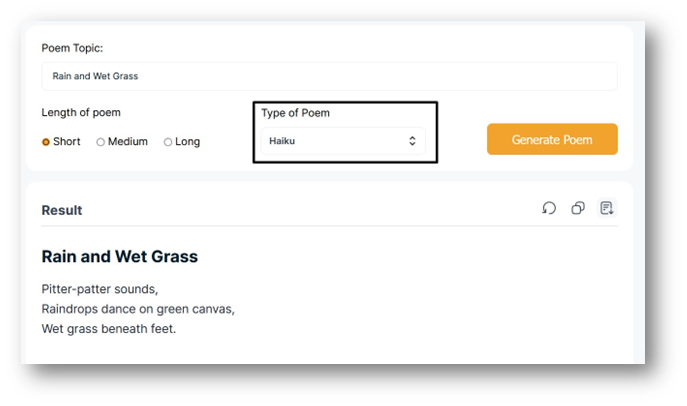
Since haikus are supposed to capture the beauty of nature, we asked the AI Poem Generator to write one whose main idea revolves around “Rain and Wet Grass”. The textual output can be seen below.
Rain and Wet Grass
Pitter-patter sounds,
Raindrops dance on green canvas,
Wet grass beneath feet.
Ballad poems follow a narrative and tell a story in a musical or rhythmic manner. Ballads usually consist of quatrains (four-line stanzas) and may seem like they’re lyrics for a song.
They have a rhyme scheme ABAB or AABB. Folklores, legends, and historical events are often recounted using ballad poems. It is also worth noting that ballads are one of the oldest forms of narratives out there. They are older than any other form of written story since they are usually passed down from generation to generation.
A ballad typically has the following structure that makes it distinct from all the other types of poems.
Quatrains: Each stanza of the poem consists of four lines that rhyme with each other. These lines are relevant to the theme of the poem.
Rhyme Scheme: The rhyme scheme in a typical ballad is kept ABAB where the first line of a stanza rhymes with the third and the second line rhymes with the fourth. AABB rhyme scheme may also be followed depending on the poet’s preference.
Repetition: In ballads, repeating lines are common. This adds to the musical quality of the poem.
When writing a ballad, the following rules have to be considered.
Narrative Focus: Ballads tell a story, so clearly focusing on the narrative and its development is important.
Simple Language: The language is often straightforward, making the story easy to follow. There is no room for complex language in ballads.
Refrain: A repeated line or stanza, often called a refrain has to be added to the poem as it helps emphasize key points and maintains rhythm.
We couldn’t find a short ballad poem so we’re using an excerpt from the famous poem “The Rime of the Ancient Mariner” by Samuel Taylor Coleridge as an example below.
“It is an ancient Mariner,
And he stoppeth one of three.
'By thy long grey beard and glittering eye,
Now wherefore stopp'st thou me?
The Bridegroom's doors are opened wide,
And I am next of kin;
The guests are met, the feast is set:
May'st hear the merry din.'
He holds him with his skinny hand,
'There was a ship,' quoth he.
'Hold off! unhand me, grey-beard loon!'
Eftsoons his hand dropt he.
He holds him with his glittering eye—
The Wedding-Guest stood still,
And listens like a three years' child:
The Mariner hath his will.
The Wedding-Guest sat on a stone:
He cannot choose but hear;
And thus spake on that ancient man,
The bright-eyed Mariner.”If you look closely, you’ll see from this excerpt that the poem follows an ABAB rhyme scheme and follows a narrative.
Crafting a great ballad becomes easy with our AI Poem Generator. It uses artificial intelligence algorithms to come up with a relevant ballad based on the provided topic. You can use it as a reference or to gather ideas.
To use the tool, you have to follow the steps that we’ve already mentioned in the first section of this post. However, when choosing the type of poem, click on “Ballad” instead of the other options. After that, you’ll get your output, as shown below.
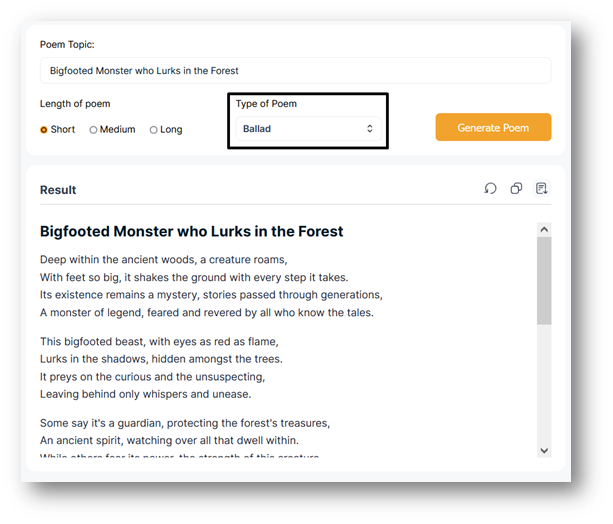
The generated poem follows an ABAB rhyme scheme, has simple words, and provides a poetic story on our provided folklore topic “A Bigfooted Monster Who Lurks in the Forest” in a great way. The textual version of it can be seen below.
Bigfooted Monster Who Lurks in the Forest
Deep within the ancient woods, a creature roams,
With feet so big, it shakes the ground with every step it takes.
Its existence remains a mystery, stories passed through generations,
A monster of legend, feared and revered by all who know the tales.
This bigfooted beast, with eyes as red as flame,
Lurks in the shadows, hidden amongst the trees.
It preys on the curious and the unsuspecting,
Leaving behind only whispers and unease.
Some say it's a guardian, protecting the forest's treasures,
An ancient spirit, watching over all that dwell within.
While others fear its power, the strength of this creature,
Believing it a monster, an embodiment of sin.
But those who venture deep into the forest's heart,
May catch a glimpse of this elusive being.
In the moonlight, its silhouette dances through the trees,
Leaving no doubt of the magic it is seeing.
For Bigfooted Monster carries the wisdom of the ages,
And in its presence, one can feel the ancient magic flow.
It reminds us of the vastness of the natural world,
And the wonders that we are yet to know.
So, let us not fear this creature of the forest,
But instead, respect it and honor its sacred space.
For Bigfooted Monster is a reminder of the unknown,
And the beauty that resides in every hidden place.
As the name suggests, a couplet is a poem that consists of only two lines. They typically have the same meter and rhyme with each other.
Since two lines aren’t enough to describe something or tell a story, couplets are often used to conclude a sonnet or other forms of poetry. They provide a sense of closure and emphasis.
A couplet usually has a simple structure, mainly because it is so short. But still, some general pointers on its structure are as follows.
Two Lines: A couplet consists of only two lines. Anything longer than that won’t be considered a couplet.
Rhyme Scheme: The lines usually rhyme with each other. They follow an AA rhyme scheme.
Meter: Couplet lines have the same meter. However, this can vary depending on the preference of the poet.
The following rules have to be followed when writing a couplet.
Clarity and Precision: Couplet poems have to have precise language to convey the intended meaning. This improves their brevity.
Closure: These poems often serve as a concluding statement to another poem or emphasize a key idea. So they should be able to provide closure or highlight a point.
“So long as men can breathe or eyes can see” by William Shakespeare can be considered a great example of a couplet.
“So long as men can breathe or eyes can see,
So long lives this, and this gives life to thee.”
This couplet was used by the poet to conclude his other poem named “Sonnet 18”.
The general steps to do this are still the same. The only different thing that you have to do here is select the “Couplet” option from the given types of poems. That said, here’s a screenshot of the tool providing us a couplet against our title “Autumn Leaves and Cool Air”.
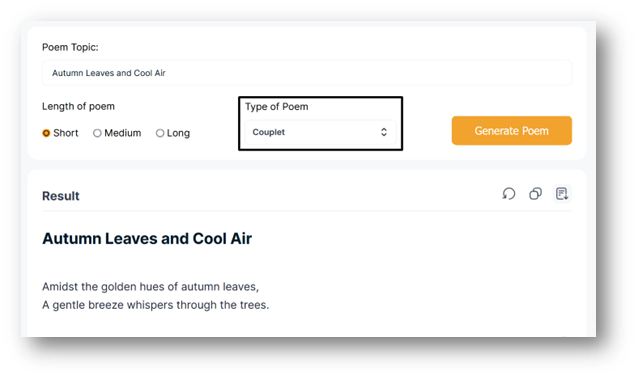
The tool came up with a perfect couplet that revolves around the given topic. The textual form of the output can be seen below.
Autumn Leaves and Cool Air
Amidst the golden hues of autumn leaves,
A gentle breeze whispers through the trees.
A sonnet is a 14-line poem that follows a specific rhyme scheme and structure that is not exactly defined well. This is because there are two main types of sonnets: The Shakespearean (or English) sonnet and the Petrarchan (or Italian) sonnet. Each of them has a different rhyme scheme.
That being said, sonnets are typically associated with love and other deep emotions. These poems explore a single theme or idea throughout them.
This type of poem usually follows a distinct structure that we’ll mention below.
14 Lines: All sonnets have 14 lines. No more and no less.
Rhyme Scheme: The Shakespearean sonnet follows an ABABCDCDEFEFGG rhyme scheme, while the Petrarchan sonnet follows ABBAABBACDCDCD.
Iambic Pentameter: Each line typically consists of ten syllables, following an iambic pentameter rhythm (unstressed syllable followed by a stressed syllable).
When writing a sonnet, some of the rules that are usually followed by poets are as follows.
Theme: Sonnets usually have to explore themes of love, beauty, politics, mortality, or nature.
Volta: A “Volta” or turn in the poem has to be included. Here, the theme or argument shifts. This typically occurs at the ninth line in a Petrarchan sonnet or the final couplet in a Shakespearean sonnet.
Closure: The final couplet or lines have to provide a resolution to the poem or bring it to a close in a good manner.
“Sonnet 18” by William Shakespeare is one of the most prominent examples of a Shakespearean sonnet. Its text is as follows.
“Shall I compare thee to a summer's day?
Thou art more lovely and more temperate:
Rough winds do shake the darling buds of May,
And summer's lease hath all too short a date:
Sometime too hot the eye of heaven shines,
And often is his gold complexion dimmed;
And every fair from fair sometime declines,
By chance or nature's changing course untrimmed;
But thy eternal summer shall not fade
Nor lose possession of that fair thou owest;
Nor shall Death brag thou wanderest in his shade,
When in eternal lines to time thou growest:
So long as men can breathe or eyes can see,
So long lives this, and this gives life to thee.”
The poem follows an ABABCDCDEFEFGG rhyme scheme, explores the theme of eternal beauty, and includes a concluding couplet at the end.
Our tool is capable of crafting a sonnet in an instant for users. All they have to do to leverage it is follow the steps mentioned in the Free Verse section but choose “Sonnet” when selecting the type of poem. After that, they will have a great sonnet on their hands that can be used for ideas or kept as a reference.
To showcase this, we gave the AI Poem Generator the topic “Between Sin and Redemption”, here’s what it came up with.
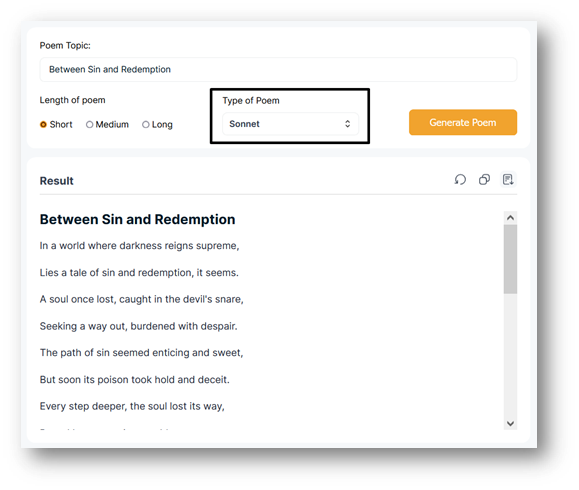
The generated poem is relevant to our input and consist of 14 lines. Its textual version is as follows.
Between Sin and Redemption
In a world where darkness reigns supreme,
Lies a tale of sin and redemption, it seems.
A soul once lost, caught in the devil's snare,
Seeking a way out, burdened with despair.
The path of sin seemed enticing and sweet,
But soon its poison took hold and deceit.
Every step deeper, the soul lost its way,
Bound by temptation, unable to stray.
But in the depths of despair, a glimmer of light,
A chance for redemption, to make things right.
A beacon of hope, breaking through the dark,
Guiding the lost soul, leaving its mark.
With each step taken, the burden grew light,
As redemption drew closer, shining so bright.
A diamante poem is a seven-line, diamond-shaped poem that begins with one subject and ends with its opposite.
It’s a visual form of poetry that contrasts two different ideas. It is both visually appealing and intellectually stimulating. Such poems are usually taught in schools to children so they can learn how to rhyme.
Such poems have one of the most unique structures out there. They follow the approach mentioned below.
Line 1: Includes one noun that can be seen as the starting subject.
Line 2: It consists of two adjectives describing the subject.
Line 3: Three verbs ending in -ing that are related to the starting subject are added here.
Line 4: It has four nouns. The first two are related to the starting subject and the last two are related to the ending subject.
Line 5: Three verbs ending in -ing related to the ending subject.
Line 6: Two adjectives describing the ending subject.
Line 7: One noun which is the ending subject.
The following rules have to be kept in mind while writing a diamante poem.
Shape: The poem has to be written in a diamond shape, with the longest line in the middle (line 4).
Opposites: Diamante poem contrasts two opposite ideas. It has to start with one subject and end with its opposite.
Brevity: Each line has to be concise. It should use single words or short phrases to convey meaning.
Poetry is a powerful form of expression that uses carefully chosen words and structured language to convey emotions and stories.
Crafting a great poem can be challenging, but an AI tool like our AI Poem Generator can be helpful in providing inspiration and assistance in various forms of poetic compositions.
Different types of poems, such as free verse, limericks, acrostics, epitaphs, haikus, ballads, couplets, sonnets, and diamantes, each have their own unique structures and rules to follow.
Utilizing the AI Poem Generator, you can easily create poems in these various forms by inputting your chosen topic and selecting the desired type of poem. Whether it's capturing the beauty of nature in a haiku or exploring contrasting ideas in a diamante, our AI Poem Generator can assist writers in crafting creative and engaging poems effortlessly.


